Showing posts with label Australia. Show all posts

Monday, April 25, 2011

Gallup Releases Latest National Wellbeing Poll Results

Gallup's deserted front desk. Apparently everyone
was out doing surveys. From The Woodlands Texas.
The Atlantic reports that Gallup, one of the world's leading statistical organizations, has released its 2010 list of countries ranked by wellbeing. Here are the top five, along with how many of its citizens are "thriving" by their own admission:

  1. Denmark:  72% thriving
  2. Sweden:  69% thriving
  3. Canada:  69% thriving
  4. Australia:  65% thriving
  5. Finland:  64% thriving
Some other interesting factoids:  the U.S. ranks 12th with 59%, which is between Panama and Austria. Also, the United Kingdom ranks 17th with 54%, which is just ahead of Qatar, but just below the United Arab Emirates. It'll be interesting to see if the U.K.'s rank improves once its Gross National Happiness measures kick into gear. As far as I know, none of the countries in the top five has official measures like that (except possibly Canada in the future).

Like the gap between the rich and the poor, there is also a huge gap in wellbeing. In 19 countries, the majority of citizens consider themselves to be thriving, yet in a whopping 67 countries, that percentage falls below 25. Russia is one of these, with 24% of its population thriving. So is China with 12%, which is even lower than Iraq, Libya, and Tunisia. The Chinese government apparently has a long way to go if they're serious about focusing on happiness (which they probably aren't).

The African nation of Chad comes in at the bottom of the list with only 1% of its population thriving. Of course, there may be worse countries out there, but those aren't even well enough to report statistics.

Tuesday, April 12, 2011

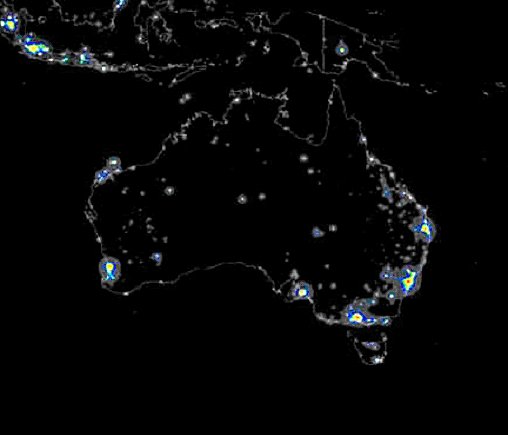
Australia at night

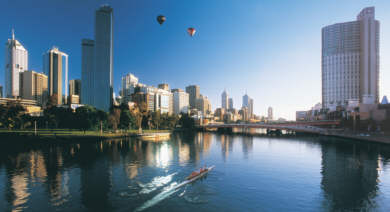
Perth is the capital and largest city of the Australian state of Western Australia. The central business district of Perth is bounded by the Swan River to the south and east, with Kings Park on the western end, while the railway lines form a northern border. Hay Street and Murray Street have most of the retail and entertainment facilities. The tallest building in the city is Central Park, which is the sixth tallest building in Australia.

The coastal suburbs take advantage of Perth's oceanside location and clean beaches. To the east, the city is bordered by a low escarpment called the Darling Scarp. Perth is on generally flat, rolling land - largely due to the high amount of sandy soils and deep bedrock. The Perth metropolitan area has two major river systems; the first is made up of the Swan and Canning Rivers. The second is that of the Serpentine and Murray Rivers, which discharge into the Peel Estuary at Mandurah.

Australia at night
Australia at night
Australia at night
Australia at night
Australia at night
Australia at night
Australia at night

Monday, April 11, 2011

People Who Change Jobs Are Happier

A completely undoctored photo of Sydney.
From Sydney-Australia.biz.
Today the Sydney Morning Herald reports on an Australian study that shows most people change jobs not to seek out more pay, but to seek out more satisfaction--and they usually find it. Around 17% of Australian workers (or 1.2 people) changed jobs in 2008, mostly for reasons of job security and job satisfaction. The National Centre for Vocational Education Research conducted the study.

Dr. Ian Watson, author of the study, says that most changes in jobs do not lead to an increase in pay or job security. "On the other hand," he says, "job changing does lead on average to greater levels of job satisfaction.'' This may occur because workers in new jobs get to learn and use new skills. The study also includes other interesting results, like how extroverts are more likely to change jobs than introverts.

Thursday, March 24, 2011

Study Shows Correlation Between Diet and Mental Disorders in Women

Mmm, depression! From Science Daily.
Today the Sydney Morning Herald reports on a new Australian study that shows eating certain foods increase the likelihood of developing depression and anxiety disorders. Lead by Deakin University research fellow Dr. Felice Jacka, the study examined around 1,000 Australian women from all stratas of society. Participants who followed the national dietary guidelines were less likely to have depression.

This correlation happened regardless of the women's socioeconomic status, education, frequency of exercise, whether they smoked or not, and even physical problems like obesity. Dr. Jacka also says, "And conversely, women who mostly ate junk and processed foods were more likely to have depression and exhibit increased psychological symptoms." The study ultimately aims to help prevent depression before it starts.

So this pretty much confirms what a lot of you probably expected anyway. Unfortunately, the news story doesn't go into much detail about how this study was carried out (by listing control groups and the like), so not much else can be inferred from it. For more on how food affects mood, remember to click on my food tag, and especially this list of good foods to eat if you want to be happy.