Showing posts with label Casual Friday. Show all posts

Friday, March 11, 2011

Casual Friday: A Trip to the Art Museum

As Aristotle was fond of saying, "There comes a time in one's life when one has no idea what to post on one's blog." For me, that time is now, so I'm just going to post a bunch of paintings that I like, because art is a great method of transmitting meaning and joy. I don't know if anyone else will like them and I don't know if most of these would even be classified as "happy" art, but they do all have a positive feeling to them. (You can click each one for the full-sized version.)
"First Steps (after Millet)" by Vincent Van Gogh. He painted this in 1890 while he was a voluntary insane asylum patient at Saint-Remy, where he also did some his most famous work (like "Starry Night").
"The Botanist" by Louis Wain. Louis Wain is one of my favorite painters, even though he's not really considered serious or deep by the art world (because he mostly painted cats with funny anthropomorphic features). He is also famous for becoming schizophrenic, with his cat paintings often looking completely abstract and psychedelic before psychedelic was even a word. You can check out other Wain paintings at Catland.
"Every Girl Should Have a Unicorn" by Dr. Seuss. Many people don't know this, but the famous children's author and artist Dr. Seuss also made paintings for adults--he just didn't release them usually. Well, his "adult" paintings are just as colorful and imaginative as the ones in his children's books, if not more so. You can see them in the excellent book The Secret Art of Dr. Seuss.
Hopefully these are some paintings you haven't seen before. I'm keeping it short so YOU feel free to post any paintings you like in the comments!

Friday, February 18, 2011

Casual Friday: The Blog Turns 100! And SPECIAL REPORT on the Roxie

Here's a photo of the blog today. From Trustar Vibrations.
Yay! Today the blog turns 100! Well, not 100 YEARS old, but 100 POSTS. Yes, this is my 100th post here, and I intend to use it in the laziest way possible.

If you don't want to be as lazy as me, go to San Francisco tomorrow. Why? Because you can see a "sneak-preview" screening of the documentary HAPPY at the Roxie Theater at 7:00 pm. Director Roko Belic will be there, and so will Melissa Moody, one of the people featured in the movie. They will hold a Q&A session after the film.

Tickets are $10, or $6 for seniors. You can order online or see more info at the Roxie website. You can also pay at the box office. As this is a non-profit, fully independent film, proceeds go toward a proper theatrical release (expensive costs borne by a movie studio or distributor on most films).

Remember:  Tomorrow, February 19, 7 pm, at this address:

Roxie Theater
3117 16th Street
San Francisco, CA 94110
(415) 863-1087

Hope you can make it!

Friday, February 11, 2011

Casual Friday: Foods That Make You Happier

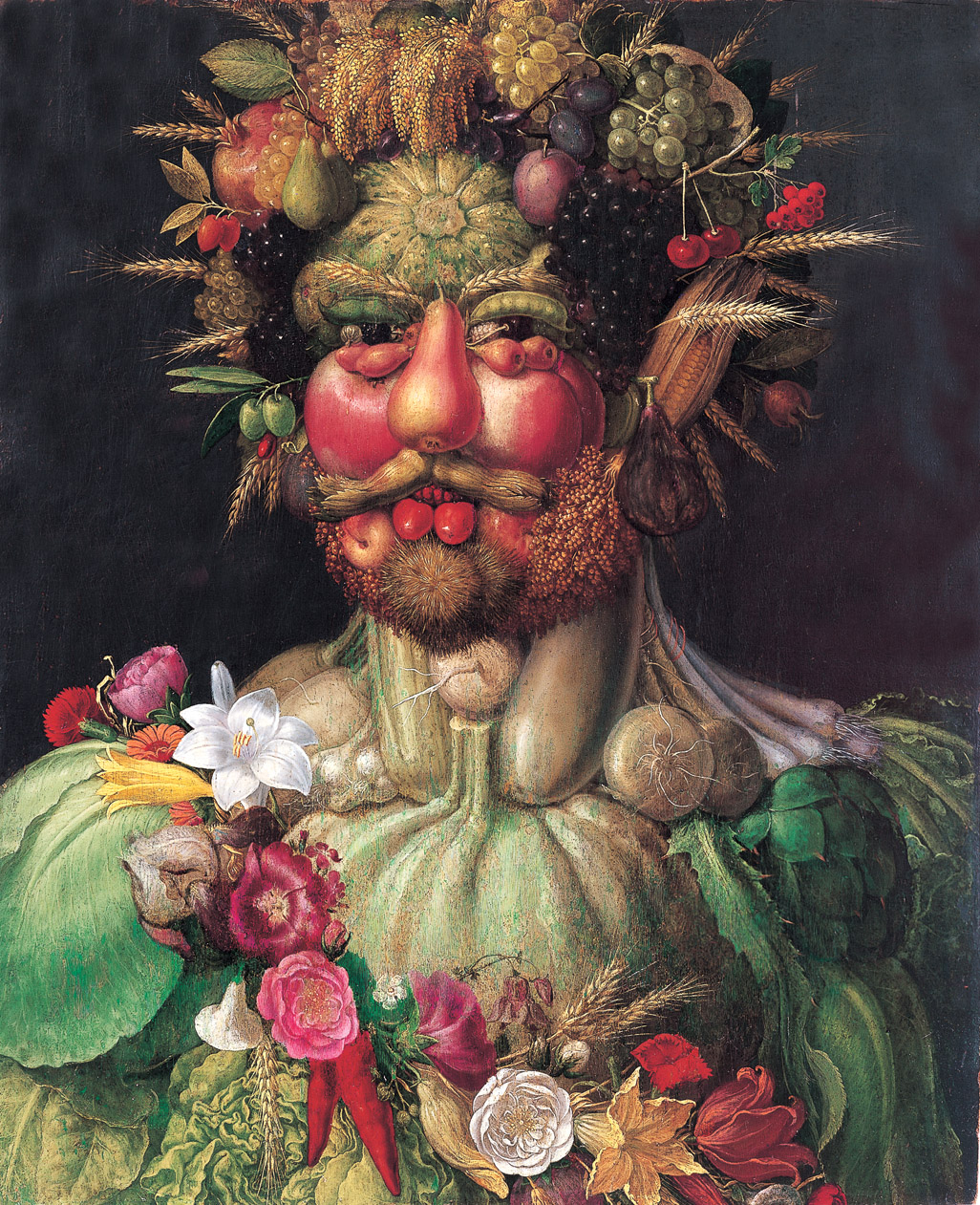
You are what you eat! Don't you want to look
like this? Portrait by Giuseppe Arcimboldo.
From Wikipedia.
Today I thought it would be nice to highlight diet tips that can improve your mood, using this article by Elsa Jones from Herald.ie and this article by Mary Bourgeois from Top Wire XS as guidance. As most of you probably know, food can have a big effect on levels of your serotonin, also known as the "happiness hormone" (even though it's a neurotransmitter, not a hormone). But what kind of diet is best? Let's find out!

  1. Eat folate-rich foods. A study by the University of York and the Hull York Medical School showed that low folate levels can lead to depression, so eat foods like peas, bananas, oranges, broccoli, and others like them.
  2. Eat protein with every meal. Protein-rich food keeps blood sugar balanced and contains tryptophan, which is necessary for serotonin production. Some good foods in this category are turkey, cottage cheese, and bananas.
  3. Eat B vitamins, especially B6. B vitamins help with serotonin production, but B6 also helps in the metabolism of red blood cells. B-vitamin foods include oats, leafy green vegetables, and eggs.
  4. Eat omega-3 foods, like fish. A study by the Journal of Clinical Psychiatry showed that eating fish capsules three times a day improved bipolar and depression patients' moods after eight weeks. This makes sense because omega-3 helps create dopamine (another neurotransmitter related to happiness) and slows the breakdown of serotonin.
  5. Eat vitamin D. Most of us don't get enough vitamin D from sunlight, especially in the winter, which can cause problems because this vitamin is a mood booster. Some good vitamin-D foods are oily fish, leafy green vegetables, and eggs.
So there you have it. Give some of these tips a try. You'll probably be glad you did!

Friday, February 4, 2011

Casual Friday: Loneliness

From Wine Press of Words.
Today is Friday, a day when many people try to put away their stress and go out with friends, so it seems as good a time as any to discuss the importance of social interaction. I'll be using the excellent book loneliness:  Human Nature and the Need for Social Connection by John T. Cacioppo and William Patrick for most of my information, so read that if you want to look deeper.

Most of you probably realize that habitual social isolation affects health negatively, but you may not know to what extent. According to a study done by epidemiologist Lisa Berkman, people with few social ties are two to three times more likely to die of ischemic heart disease, circulatory disease, cancer, respiratory failure, gastrointestinal failure, and all other causes of death. This makes extreme loneliness just about as dangerous as obesity, lack of exercise, or smoke inhalation.

Many researchers were skeptical of such harsh results, but studies since then have supported them. One of the most extensive studies of loneliness was conducted by the authors (Cacioppo and Patrick) themselves. At Ohio State University, they gave volunteer test subjects a battery of tests, including not only daily surveys of their subjective wellbeing, but also objective physiological measurements like blood tests, salivary gland tests, and even sleep tests. The results show that lonely people (especially older people) experience chronic stress at a 25% higher rate, and this stress compounds over a lifetime. On brain scans they are even less happy than normal when they DO finally experience social connection.

Okay, so now that (I hope) I've convinced you that loneliness is a serious health problem, what counts as loneliness? The authors define it as a lack of meaningful social interaction. The interaction has to be meaningful because people standing in a crowded mall can be just as lonely as someone alone in a basement, if not more so. If you feel better with a small group of friends than a large one, that's okay. It's the quality of the interaction that counts, not the quantity.

As for how to get out of a lonely slump, that's a difficult question. You might start by looking for people with similar interests as you. I recommend the website Meetup, which allows you to find groups and clubs in your area, then meet them in person. The important thing is to keep trying, even if it doesn't seem to go well at first (loneliness can amplify negative feelings of yourself, even when you have no cause for concern).

This post is already rather long, so might as well go read the book at this point. Just remember that everyone goes through these feelings at some point, so even if you're lonely, you're not alone.

Friday, January 28, 2011

Casual Friday: "Happiness Tips for the Unemployed"

Thankfully the streets don't look like this
just yet. From The Omaha Project.
It's been awhile since I've read any new books relating to happiness, so again I turn to the Internet for guidance. Today I found this interesting article by Aaron Jacobsen and Michelle Santos of Tiny Buddha. It's a list of five tips to help you avoid despair if you are unemployed (which you very well might be, according to the latest figures).

Some of these tips may be common sense, but even if they are, hearing/reading them from an outside source can help. Again, you should read the actual article for explanations, but here is a summary of the list:

  1. Identify your emotions. When you think about what you're feeling and give it a label you can act accordingly instead of reacting impulsively.
  2. Keep going to social activities. Negative emotions tend to amplify in isolation.
  3. Try to think positively. This may be hard to believe, but studies show that positive thinkers actually have a more accurate view of the obstacles in their life, while too many negative thoughts can give you tunnel vision.
  4. Stay open to different career paths. You'll find more opportunities if you're willing to change from a banker to a nurse (for example) than if you always try to stick to one career.
  5. Take advantage of your free time. This may sound a bit callous, but losing your job DOES give you more free time. Since you're not on the job from 9 to 5 anymore, you might as well take advantage of your free time by doing any hobbies that make you happy or by developing any of your lesser-used skills.
Anyway, these are just some tips to keep in mind. Just remember that getting back on your feet may be difficult, but it doesn't have to be impossible!

Friday, January 21, 2011

Casual Friday: "9 Easy Ways to Be Happier"

From Real Simple.
In my quest to do as little work as possible, sometimes it's nice to have a helping hand. Today I can get away with even less work than usual because Julia at The Thank You Project tipped me off to this article by Marcia Menter from Real Simple. It's a look at nine easy ways to be happier.

You should go to the actual article to look at the pretty pictures and read the explanations, but here's a summary of the list:

  1. Cool yourself off. Cool temperatures apparently produce better moods than hotter temperatures (could have fooled me).
  2. Remember happy times in your past. Nostalgia can be a great mood booster.
  3. Don't obsess over past failures. This goes hand-in-hand with the previous tip.
  4. Give away money. As I've said before, generosity toward others makes YOU feel happier.
  5. Eat a snack around 2 p.m. This is the time of day when serotonin levels dip, and a snack can help.
  6. Exercise. It boosts mood and helps your brain.
  7. Limit your choices. This may be counterintuitive, but too many options at once can produce unnecessary stress.
  8. Learn a new skill. This gives you variety and sense of accomplishment.
  9. Make your bed. Eh? Well apparently doing little tasks like this can make you more satisfied throughout your day.
Anyway, it's a good, easy list with some stuff I've never read before. Also, I love getting tipped off because it means I don't have to scrounge around for something to post! If you'd like to make my job easier, go ahead and tip me off to interesting articles, books, or videos in the comments section or through email. See ya!

Friday, January 14, 2011

Casual Friday: Eiji on CNN Asia

From CNNGo.
Today we have a very interesting story that many of you already know, but it's cool to see in the media anyway. Our friend and producer Eiji Han Shimizu was featured on CNNGo, CNN's Asian division. Eiji is known for creating BioGraphic Novels, his line of graphic novels about real life heros like Gandhi and Mother Teresa. Also featured is Tom Shadyac, one of the most successful comedy directors ever and our executive producer.

Anyway, the story is pretty good, and features pictures that even I haven't seen, so give it a read!